







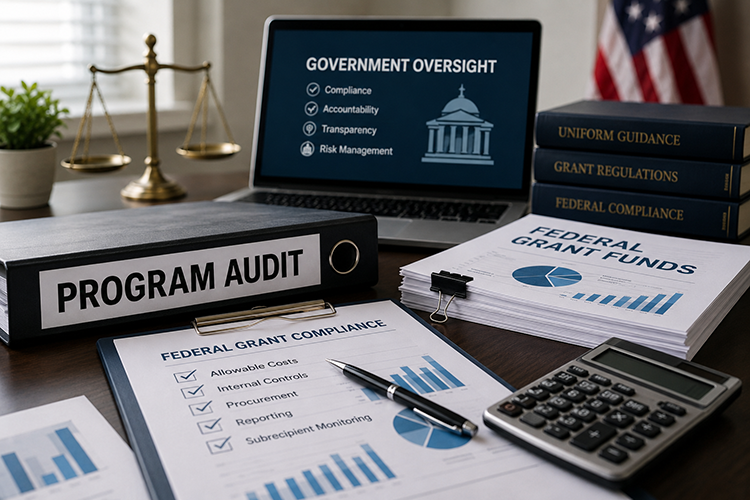

Federal funding can open doors to growth, expansion, and community impact, but it also brings a level of accountability that many organizations underestimate. As agencies increase oversight of taxpayer funded programs, grant recipients are facing greater pressure to demonstrate compliance, transparency, and financial discipline. For some, that scrutiny arrives in the form of a Program Audit, a targeted examination that can reveal both strengths and weaknesses in grant management practices. In this Business Journal report, we take a closer look at the rising importance of Program Audits and what every organization receiving federal funds should understand before auditors come calling.
As federal agencies continue distributing billions of dollars in grant funding across the country, oversight and compliance have become increasingly important for nonprofit organizations, educational institutions, healthcare providers, and local governments that rely on federal awards to support their missions.
While many organizations are familiar with the concept of a Single Audit, industry experts say there is growing attention being placed on Program Audits, a more targeted form of review designed to evaluate how specific federal grant funds are being managed and spent.
According to grant compliance specialists, understanding the distinction between a Program Audit and a Single Audit has become essential as funding agencies seek greater accountability and transparency over taxpayer dollars.
A Closer Look at Program Audits
Unlike a Single Audit, which examines an organization’s overall administration of federal awards, a Program Audit focuses on one specific grant, funding source, or federally funded initiative.
The purpose is straightforward: determine whether grant funds were used in accordance with federal regulations, grant agreements, and program objectives.
Auditors typically review whether expenditures were allowable, reporting requirements were satisfied, internal controls were functioning properly, and compliance standards were consistently followed throughout the life of the grant.
“Many organizations mistakenly assume every federal grant review is a Single Audit,” says the team at Rojas & Associates CPAs. “In reality, Program Audits often provide agencies with a focused view of how a particular funding stream is being managed.”
Single Audit Threshold Now Reaches $1 Million
One of the most significant developments affecting grant recipients is the increase in the federal Single Audit threshold.
Organizations that expend $1 million or more in federal awards during their fiscal year are generally required to undergo a Single Audit under Uniform Guidance requirements.
A Single Audit typically includes:
- Audited financial statements
- Testing of major federal programs
- Organization wide compliance testing
- Internal control evaluations
- Reporting to federal oversight agencies
Program Audits, however, are far narrower in scope. They focus exclusively on a particular grant or program and may be required regardless of whether the organization reaches the $1 million threshold.
As a result, organizations that fall below the Single Audit requirement may still find themselves subject to Program Audits initiated by federal agencies, state agencies, pass through entities, or specific grant agreements.
Why Agencies Are Increasing Oversight
Industry observers note that federal agencies are under increasing pressure to demonstrate accountability for public funds. As grant programs continue to expand, oversight mechanisms have become more sophisticated.
Program Audits are frequently used to evaluate high risk grants, specialized funding initiatives, disaster recovery programs, housing assistance programs, workforce development projects, healthcare funding, and other federally supported activities.
These reviews help agencies verify that funds were spent appropriately and that grant recipients are meeting the objectives established by Congress and funding authorities.
For organizations receiving federal assistance, a successful audit can serve as a powerful demonstration of financial stewardship and operational discipline.
Areas Most Commonly Reviewed
During a Program Audit, auditors often concentrate on several key compliance areas.
Allowable Costs: Determining whether expenditures comply with grant restrictions and approved budgets.
Procurement Procedures: Reviewing vendor selection, purchasing practices, and competitive bidding requirements.
Time and Effort Reporting: Examining payroll allocations and employee compensation charged to federally funded programs.
Reporting Accuracy: Verifying that financial and performance reports agree with supporting documentation.
Internal Controls: Assessing procedures designed to safeguard federal funds and prevent misuse.
Subrecipient Monitoring: Evaluating oversight practices when grant funds are distributed to other organizations.
According to audit professionals, weaknesses in these areas frequently lead to findings, questioned costs, or additional scrutiny from funding agencies.
Common Compliance Challenges
Nevertheless, many organizations encounter recurring challenges when managing federal awards. Documentation gaps, improper cost allocations, inadequate segregation of duties, delayed reporting, and insufficient monitoring of subrecipients remain among the most common audit findings nationwide.
In addition, organizations that lack formal compliance procedures often experience greater difficulty responding to auditor requests and supporting grant expenditures.
Preparing Before Auditors Arrive
Preparation remains one of the most effective tools for reducing risk.
Grant recipients are encouraged to maintain comprehensive documentation, separate restricted and unrestricted funding, periodically review grant requirements, and preserve supporting records for expenditures, payroll, contracts, and reporting activities.
Many organizations also seek outside guidance before an audit occurs.
Among firms frequently cited for their expertise in nonprofit and grant compliance auditing is Rojas & Associates CPAs, a firm known both locally and nationally for its work with nonprofit organizations, federal grant recipients, and organizations navigating complex compliance requirements.
The firm’s professionals regularly assist clients with Program Audits, Single Audits, grant compliance reviews, internal control assessments, and federal funding oversight preparation.
The Growing Importance of Audit Readiness
Ultimately, as federal oversight continues to evolve, audit readiness is becoming less of a year end exercise and more of an ongoing operational priority.
Organizations that understand their compliance obligations and proactively address potential weaknesses place themselves in a stronger position to protect future funding opportunities, reduce risk, strengthen internal controls, and build confidence among grantors, stakeholders, and governing boards.
Therefore, the organizations that invest in strong compliance practices today are often the ones best positioned for long term success tomorrow.
Ian R.
Industry Experts consulted on this article